How to Decide If Your Company Is Ready for an EcoVadis Rating

Most companies approach EcoVadis backwards. They wait until a major customer mandates a rating, panic, and submit whatever policies they can find. The result is a poor score that takes 12 months to correct. But rushing into an assessment prematurely is just as damaging as ignoring the pressure entirely. EcoVadis readiness is not a simple binary state; it is a spectrum dictated by your position in the value chain and your internal maturity.
The CSDDD trickle-down effect
The Corporate Sustainability Due Diligence Directive (CSDDD) will fundamentally alter European supply chains by mid-2027. Even if your company is not directly in scope, your enterprise customers almost certainly are. This regulatory pressure forces large companies to audit their suppliers. In 2024, 57% of companies reported adopting risk-mapping tools, and the average EcoVadis score reached 53.4.
The question is no longer if you will be asked to prove your sustainability credentials, but when. The answer depends on which of the three tiers your organisation falls into.
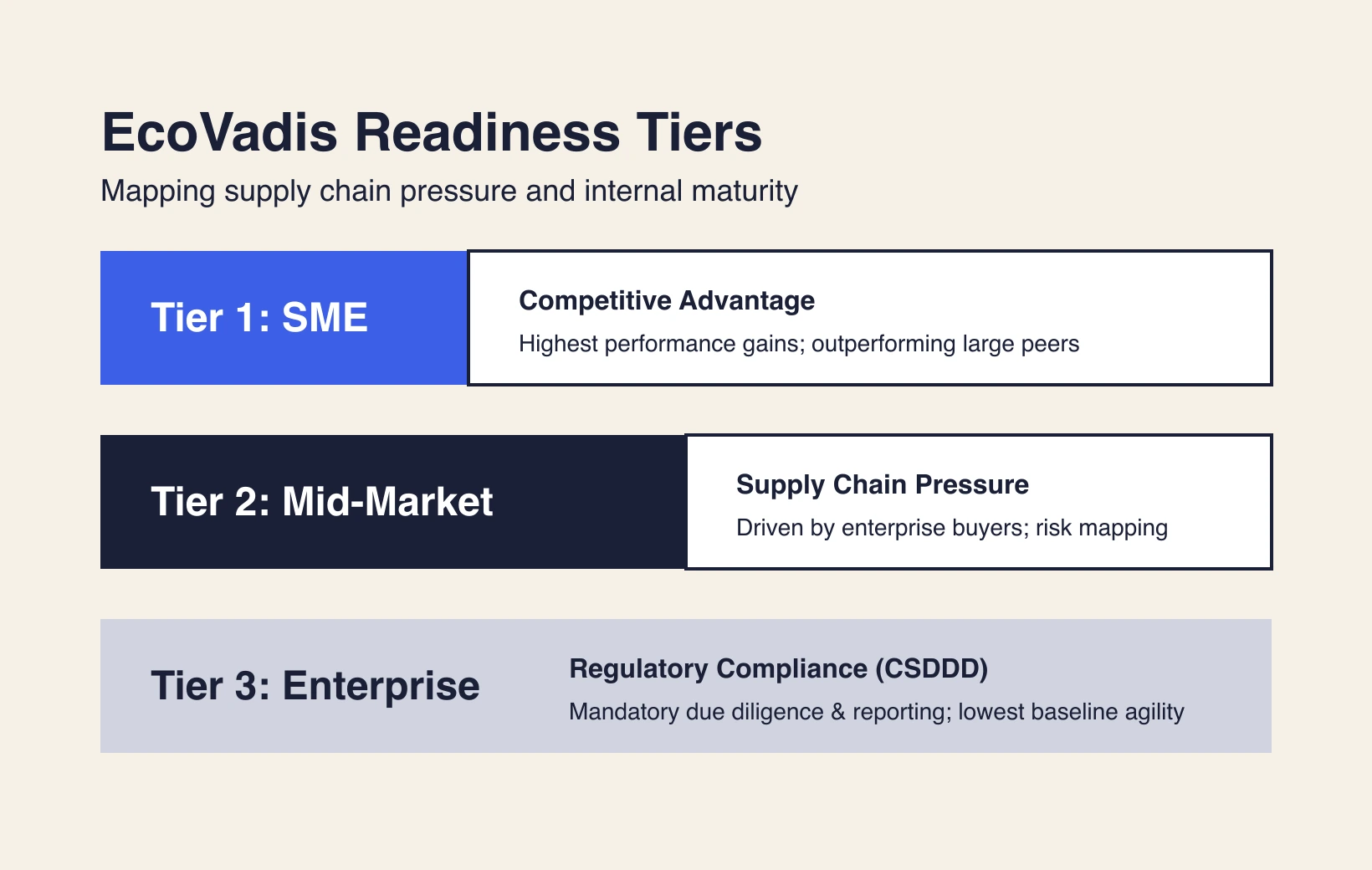
Tier 1: The SME competitive advantage
Counterintuitively, SMEs are outperforming larger companies overall and in three of the four EcoVadis assessment themes. If you are a small-to-medium enterprise, an EcoVadis rating is rarely a mandatory compliance exercise. It is a sharp sales asset.
When your enterprise buyers are scrambling to map their supply chain risks, handing them a Silver or Gold EcoVadis medal makes you the safest choice on their procurement roster. You are removing friction from their compliance obligations. For SMEs, EcoVadis readiness means having basic, documented evidence of existing good practices. You do not need complex global frameworks; you need dated records of safety training, a simple code of conduct, and proof that you manage your waste legally.
SMEs are outperforming larger companies overall and in three of four EcoVadis assessment themes.
Tier 2: Mid-market supply chain pressure
For mid-market companies, the pressure is almost entirely customer-driven. You sit in the squeezed middle: large enough to be a material supplier to enterprise buyers, but rarely large enough to justify a dedicated sustainability team.
If you are losing RFPs because you cannot demonstrate sustainability maturity, or if key clients are issuing deadlines for compliance, you are ready for EcoVadis. The goal here is not immediate perfection. It is to establish a credible baseline score—typically around 45 to 50—and demonstrate year-on-year improvement.
Do not treat your first assessment as a test you must cram for. Treat it as a gap analysis that funds your sustainability roadmap.
To succeed at this tier, you must formalise ownership. A mid-market firm cannot rely on the HR director handling Labour & Human Rights in their spare time while the legal counsel sketches out an Ethics policy over the weekend. EcoVadis readiness at this level requires a dedicated project manager to corral evidence, enforce version control, and align policies with actual operational records.
Tier 3: Enterprise regulatory compliance
At the enterprise level, EcoVadis shifts from a market differentiator to a core compliance mechanism. If you are in scope for CSRD or CSDDD, your EcoVadis rating acts as a public proxy for your governance maturity.
Enterprise readiness requires robust, dedicated ownership across HR, Procurement, and EHS to ensure evidence is comprehensive, dated, and company-specific. You must be able to prove that global policies are consistently implemented at the site level. A group-level human rights commitment is meaningless to EcoVadis without the corresponding local training records and audit results to back it up.
At this tier, EcoVadis readiness is synonymous with audit readiness. If an external auditor cannot trace a policy commitment down to a specific KPI or corrective action, neither will the EcoVadis analyst.
Start tracking evidence, not just policies
Your EcoVadis score reflects what you can prove, not what you intend to do. Do not start your journey by answering the questionnaire. Start by building an evidence register. Identify your existing policies, attach the procedures that make them work, and locate the dated records that prove they are active. When you have concrete proof of routine, you are finally ready to be rated.
Ajaya Gupta Ainapur
Ajaya Gupta Ainapur is the founder of Ainapur Consulting, specialising in strategy execution and performance management for the mining and resources sector.